Six hours, every night, at fifty
What 15 years of moderate sleep restriction does to a face. The 90% of the effect that is not the eye bags, and what the 10% conceals about the rest.
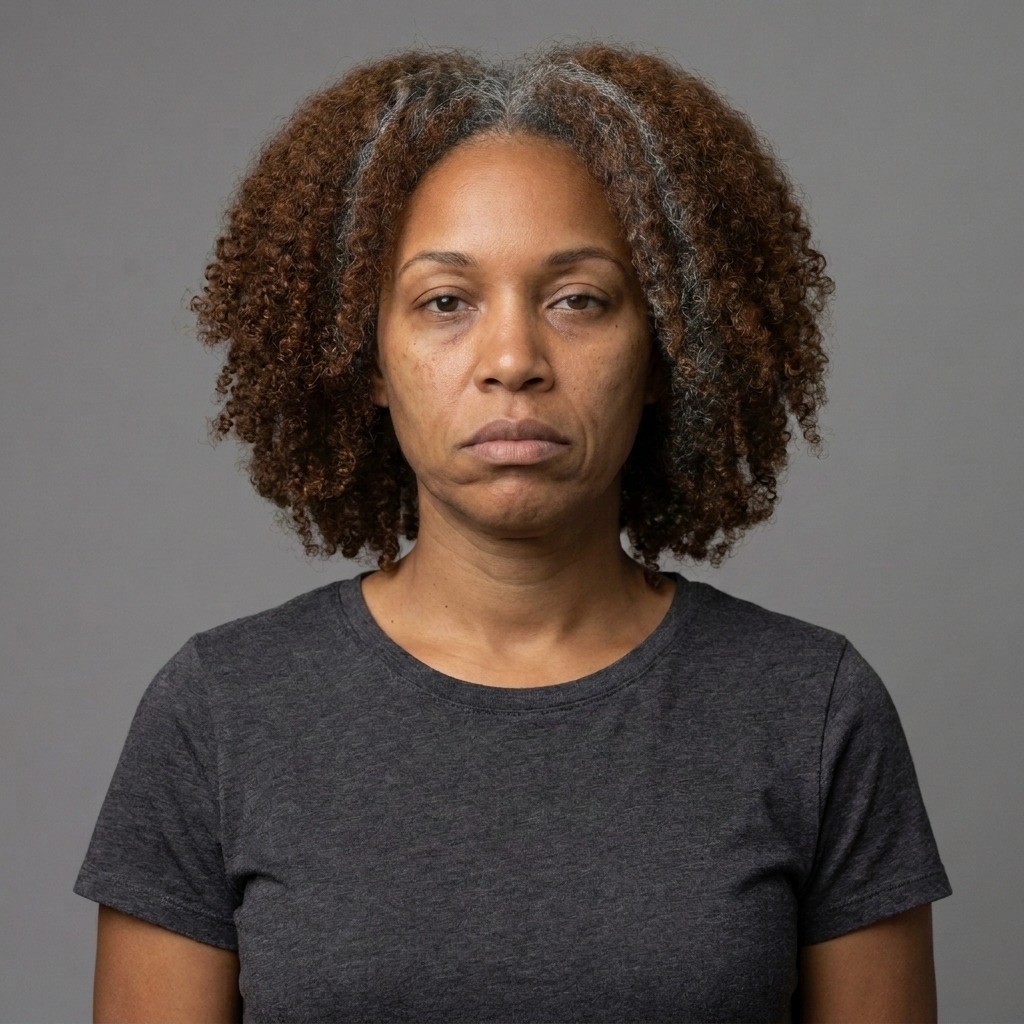
Most discussions of sleep and appearance get distracted by the obvious thing. The eye bags. The undereye darkness on the morning after a bad night. We've all seen them. We've all seen them go away after one or two good nights.
Those visible-tomorrow effects are real, but they are not what this is about. Most people overestimate the surface-level cost of bad sleep and underestimate the structural cost. The structural cost is what the face is keeping a record of. It is not visible the next morning. It is barely visible at five years. At fifteen years, it is unmistakable.
This is an essay about the structural cost — what 6 hours of sleep, every night, for a long time, does to the face that has to live with it.
The thing that is not the eye bags
When you sleep less than your body needs, three biological things happen that don't reset overnight:
- Cortisol rises, and stays elevated longer through the day than it should. Cortisol is the hormone responsible for, among other things, breaking down collagen.
- Growth hormone falls. Most of the body's growth-hormone-driven tissue repair happens in the deeper stages of slow-wave sleep. Cut sleep, cut the window.
- Inflammatory markers (CRP, IL-6) drift upward over time. Chronic low-grade inflammation is the slow corrosive of skin elasticity, joint cartilage, and a long list of other tissues you do not want to lose elasticity in.
You will not feel any of these on Tuesday morning. They are not symptoms; they are baseline shifts. The interesting thing — the thing the face quietly records — is what they do over five, ten, fifteen years of accumulation.
Less collagen, less repair, more inflammation. Skin that loses its bounce a little faster than it should. Eyes that look tired even when you slept fine last night. A jawline that softens earlier. A forehead that creases in patterns shaped by which nights you didn't recover from.
Each one of these is small. Together, over a decade and a half, they are the difference between two faces.
What the literature actually shows
A few studies are worth knowing, since they ground what otherwise sounds like wellness-influencer talk.
Sundelin et al. (2017), published in Royal Society Open Science, asked observers to rate photographs of faces taken under two conditions: after a normal night and after sleep restriction. The sleep-restricted faces were rated as less attractive, less healthy, sadder, and less approachable. The observers had not been told which photo was which. They were responding to something the face was emitting.
Oyetakin-White et al. (2015) measured skin barrier recovery, intrinsic skin aging, and "perceived facial age" in poor vs. good sleepers. Poor sleepers had measurably worse skin barrier function, slower recovery from UV exposure, and were judged to look older than their chronological age.
Axelsson et al. (2010) is the foundational paper on this — a small but cleanly-designed study showing that 31 hours of sleep deprivation produced measurable changes in observers' ratings of attractiveness, health, and tiredness, even from passport-style photographs.
These are short-window studies. The accumulated effect of chronic moderate sleep restriction — the 6.5 hours a night, every night, for 15 years — is harder to study because nobody runs a 15-year RCT. But the mechanism stack is well-understood, the short-term effects replicate, and the people who study sleep professionally do not sleep 6 hours a night by choice.
The compounding part
Most habit choices are like compound interest in reverse. The interest rate is small. The compounding period is long. Year-over-year you barely see a difference. Decade over decade you cross a threshold.
Sleep is one of the most compounded habits the face records. Six hours a night, every night, takes about seven years to produce noticeable structural effects in most people. By year fifteen, the gap between a 6-hour sleeper and an 8-hour sleeper of the same age is large enough that strangers can guess which one you are.
This is not because the 6-hour sleeper looks 'old.' Aging happens regardless. It is because the baseline trajectory — the version of yourself you are aging toward — is shifted earlier by the unrepaired tissue.
What Precog reads from this
Precog has a sleep slot for the same reason it has an exercise slot and a water slot: because the face keeps the score. We do not have a magic predictive algorithm. What we have is the same thing dermatologists, sleep researchers, and concerned grandmothers have always had — the knowledge that habits show up on the body, and the body's most-watched surface is the face.
What the AI portrait does, on top of that knowledge, is collapse the temporal gap. You don't have to wait fifteen years to see what fifteen years of 6-hour sleep produces in your face. You see a plausible version of it on Sunday at 7 PM, drawn from this week's logs, projected forward.
The portrait is not a promise. It is a calibration tool. It corrects the intuition — almost universal — that what we did this week doesn't really matter. It does. The face will tell you, eventually. We bring that telling forward by a decade and a half.
A note on the people who read this and do nothing
If you read this essay and feel mildly worried but don't change anything, that is the most common outcome. We're not naive about it. The tightness of the link between bad sleep and visible long-term effects has been known to humans for a long time. The 6-hour night has been winning anyway.
What changes the math, if anything does, is contact. Not knowledge. Not warnings. Not photos of strangers who look bad. Contact with the version of yourself, drawn from your own face, in the future you are currently choosing.
That is the smallest thing Precog tries to be. A mirror that catches the slow choice.
— Codeful